Author: ElevatDigi

  • How Businesses Can Reach the Right Customers with Programmatic Advertising

    How Businesses Can Reach the Right Customers with Programmatic Advertising

    Running ads online is easy. Getting those ads in front of the right customers is where the real challenge begins.

    A business can spend a significant amount on digital advertising and still struggle to generate meaningful results if the ads are being shown to people who have little interest in the product or service. This is one of the reasons businesses are increasingly exploring programmatic advertising.

    Programmatic advertising uses technology and audience data to automate the process of buying digital advertising space. Instead of manually choosing individual websites and placing ads, businesses can use programmatic platforms to identify audiences that match their requirements and show advertisements to them across relevant digital channels.

    For businesses looking to make their advertising more targeted and measurable, working with a Programmatic Advertising Agency in Kolkata such as ElevateDigi can provide the expertise needed to plan, launch, and optimise these campaigns effectively.

    What Is Programmatic Advertising?

    Programmatic advertising is an automated way of buying and displaying digital advertisements. It uses software, data, and algorithms to decide where and when an advertisement should appear.

    Think of a business that sells premium furniture. Instead of simply displaying an advertisement to everyone browsing the internet, a programmatic campaign can be designed to reach people whose online behaviour and interests indicate that they may be interested in furniture, home improvement, interior design, or related products.

    The objective is simple: show the right advertisement to the right audience at the right time and in the right environment.

    The technology behind programmatic advertising handles much of the advertising process automatically, allowing businesses to reach audiences at a much larger scale than traditional manual media buying.

    Why Reaching the Right Customer Matters

    Not every person who sees an advertisement is a potential customer.

    Imagine a company selling business software. Showing its advertisement to thousands of people may create a large number of impressions, but many of those people may have no need for the product. The business may receive visibility, but that visibility does not necessarily translate into enquiries or sales.

    Effective advertising is therefore not just about reaching more people. It is about reaching more relevant people.

    Programmatic advertising allows businesses to use audience signals and campaign data to make their advertising more focused. This can help reduce unnecessary impressions and give brands more opportunities to connect with people who are genuinely relevant to their products or services.

    How Does Programmatic Advertising Help Businesses Find the Right Audience?

    Understanding Your Target Customer

    Every successful advertising campaign starts with understanding who the business wants to reach.

    Age, location, interests, online behaviour, browsing patterns, previous interactions with a brand, and other audience signals can help define the ideal customer.

    For example, a Kolkata-based luxury interior design company may want to reach homeowners and people showing an interest in premium home décor rather than simply targeting everyone in the city.

    Programmatic advertising allows these audience considerations to become part of the campaign strategy.

    Using Data to Improve Audience Targeting

    One of the major advantages of programmatic advertising is its ability to use data when deciding where advertisements should appear.

    Businesses can define audience segments based on relevant characteristics and behavioural signals. The campaign can then use these signals to identify advertising opportunities that are more relevant to the intended audience.

    This does not mean that every impression will result in a customer. Advertising always involves uncertainty. However, better targeting can make the campaign more relevant and reduce the amount of advertising exposure going towards audiences that are unlikely to be interested.

    Reaching Customers Across Different Websites and Channels

    Your potential customers do not spend all their time on one website.

    They may read news, watch videos, browse blogs, research products, compare services, or use different apps and websites throughout the day.

    Programmatic advertising can help businesses reach relevant audiences across a broad digital ecosystem rather than depending on a single advertising platform.

    This gives businesses an opportunity to maintain visibility throughout different stages of the customer’s online journey.

    How Retargeting Can Bring Potential Customers Back

    Sometimes a person visits your website, looks at a product, and leaves without making a purchase. That does not necessarily mean they are not interested.

    They may simply need more time to compare options, discuss the purchase, or make a decision.

    Retargeting allows businesses to reconnect with certain users who have previously interacted with their website or digital content, subject to applicable platform rules, consent requirements, and privacy regulations.

    For example, an online furniture store could show relevant advertisements to people who previously viewed particular products. This can help keep the brand in consideration while the customer continues their research.

    For many businesses, this is particularly useful because the customer has already demonstrated some level of interest.

    Programmatic Advertising Is More Than Just Display Ads

    When people hear the term programmatic advertising, they often think only about banner advertisements.

    In reality, programmatic buying can support several types of digital advertising environments, depending on the platforms, inventory, audience, and campaign objectives involved.

    Display advertising, video advertising, connected TV and other digital formats can form part of a programmatic strategy. The right mix depends on the business, its audience, budget, creative assets, and overall marketing objectives.

    This is why programmatic advertising should not be treated as a one-size-fits-all solution.

    How Businesses Can Make Programmatic Advertising More Effective

    Start With a Clear Business Objective

    Before launching a campaign, a business should know what it is trying to achieve.

    Is the objective brand awareness? Website traffic? Product consideration? Leads? Sales?

    A campaign designed to build awareness will naturally be structured differently from a campaign designed to generate enquiries. Defining the objective first makes it easier to select suitable audiences, creative formats, targeting methods, and performance measurements.

    Create Relevant Advertisements

    Even excellent targeting cannot compensate for poor creative.

    If the advertisement does not communicate a clear message or give the audience a reason to take action, reaching the right person may still produce limited results.

    Businesses should therefore make sure their advertisements are visually appropriate, easy to understand, and aligned with the expectations of the audience they are targeting.

    Measure What Actually Matters

    A campaign can generate millions of impressions and still fail to support the business objective.

    Instead of focusing only on impressions, businesses should consider relevant metrics such as reach, click-through rate, conversions, cost per acquisition, qualified leads, and revenue where reliable tracking is available.

    The most useful metrics depend on the campaign objective.

    Keep Optimising the Campaign

    Digital advertising is rarely a “set it and forget it” activity.

    Audience behaviour can change. Some placements may perform better than others. Certain creative formats may generate stronger engagement. Campaign data can reveal opportunities to adjust targeting, budget allocation, messaging, and other variables.

    Regular optimisation helps businesses learn what is working and make more informed decisions over time.

    Why Businesses May Work With a Programmatic Advertising Agency

    Programmatic advertising can appear complicated to businesses that are unfamiliar with the technology behind digital media buying.

    There are platforms to understand, audiences to define, creative formats to manage, tracking to configure, and performance data to analyse. Poor campaign setup can also result in advertising spend being directed towards placements or audiences that do not contribute meaningfully to the business objective.

    This is where an experienced agency can add value.

    At ElevateDigi, programmatic advertising is approached as part of a broader digital marketing strategy rather than as an isolated advertising activity. The focus is on understanding the business, identifying relevant audiences, selecting appropriate campaign approaches, and continuously evaluating performance.

    For a business searching for a Programmatic Advertising Agency in Kolkata, the goal should not simply be to find someone who can launch advertisements. It is important to work with a team that understands the relationship between audience targeting, creative strategy, media buying, measurement, and the actual business objective.

    Is Programmatic Advertising Suitable for Every Business?

    Programmatic advertising can be useful for many businesses, particularly those looking to reach specific audiences at scale. However, it is not automatically the right choice for every company or every campaign.

    The suitability depends on factors such as the target audience, advertising budget, campaign objective, available creative assets, sales cycle, website or landing page experience, and ability to track meaningful outcomes.

    A business should therefore evaluate programmatic advertising based on its own marketing requirements rather than adopting it simply because it is a popular advertising technology.

    The Future of Smarter Digital Advertising

    Online customers have more choices than ever before. They can compare brands, research products, read reviews, and switch between different platforms before making a purchase decision.

    This makes relevant advertising increasingly important.

    Programmatic advertising gives businesses a technology-driven way to manage digital media buying and reach audiences across different online environments. When combined with strong creative, accurate measurement, and a clear marketing strategy, it can become an important part of a company’s digital advertising efforts.

    For businesses in Kolkata and beyond, the opportunity is not simply about showing more advertisements. It is about making each advertising opportunity more relevant to the people a business actually wants to reach.

    With the right strategy and continuous optimisation, programmatic advertising can help businesses move from simply buying advertising space to making more informed decisions about who they want to reach, where they want to reach them, and when they want to engage them.

    Frequently Asked Questions

    What is programmatic advertising in simple terms?

    Programmatic advertising is an automated way of buying digital advertising space. Instead of manually purchasing individual ad placements, technology helps businesses identify suitable advertising opportunities and reach selected audiences across digital platforms.

    Is programmatic advertising suitable for small businesses?

    It can be, depending on the business objective, target audience, available budget, and campaign requirements. A smaller business should first determine whether programmatic advertising can realistically support its marketing goals before investing in it.

    How does programmatic advertising target customers?

    Programmatic campaigns can use different audience and behavioural signals to identify people who may be relevant to a business. The exact targeting options depend on the advertising platform, available data, campaign setup, and applicable privacy requirements.

    Is programmatic advertising better than social media advertising?

    They serve different purposes and offer different targeting and inventory options. Social media advertising operates within specific social platforms, while programmatic advertising can provide access to a wider range of digital advertising environments. The appropriate approach depends on the business and campaign objective.

    How can ElevateDigi help with programmatic advertising?

    ElevateDigi can help businesses plan and manage programmatic advertising campaigns by focusing on audience targeting, campaign strategy, creative requirements, performance tracking, and ongoing optimisation. The approach can be tailored according to the business’s objectives, target audience, and advertising requirements.
  • SEO for a New Website: A Complete Guide to Building Search Visibility from Day One

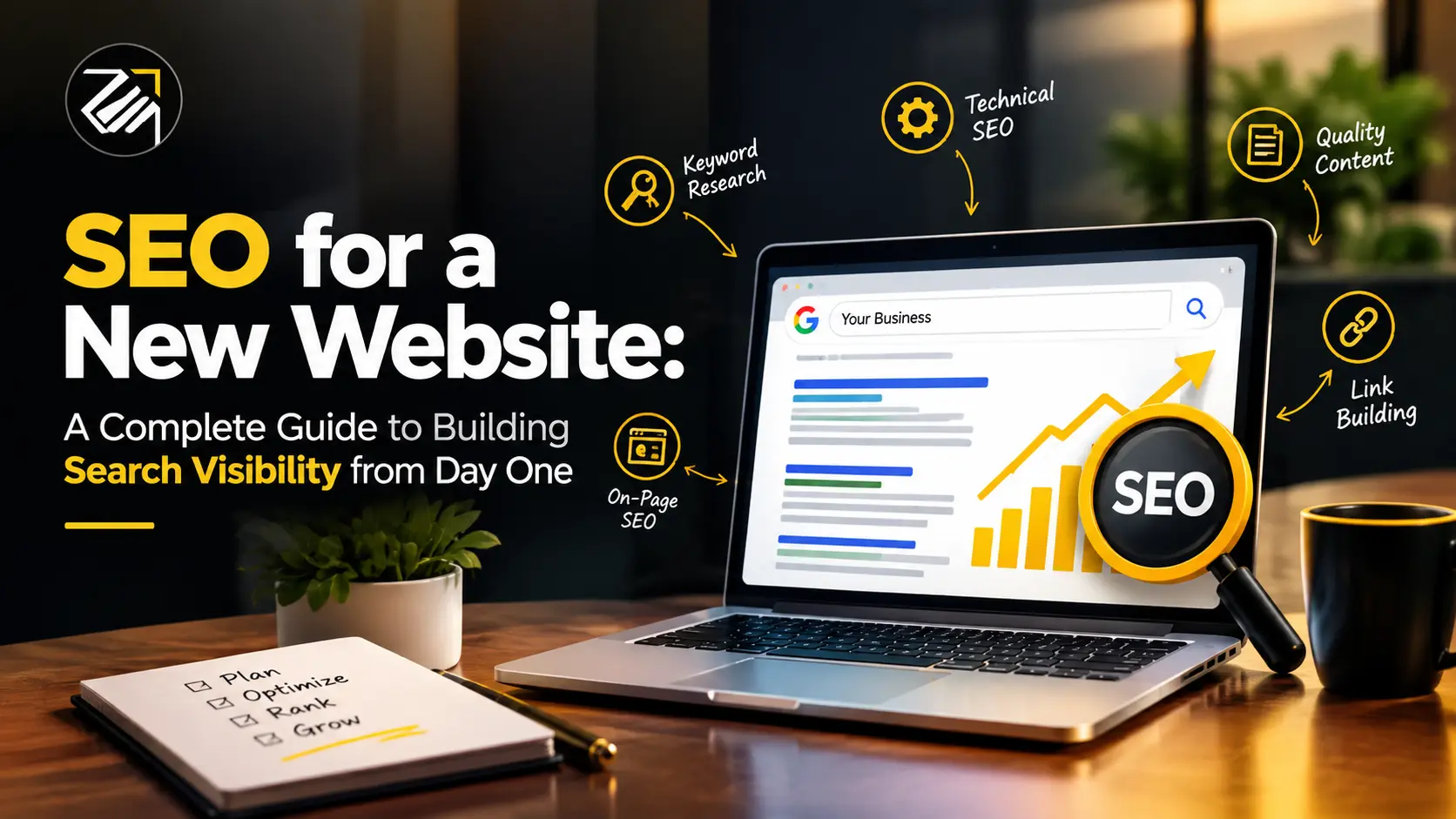
    SEO for a New Website: A Complete Guide to Building Search Visibility from Day One

    Summary

    Launching a new website is an important step for any business, but simply putting a website online does not guarantee visitors from Google. Search engines need to understand what your website is about, which topics you cover, and whether your pages provide useful information to people. This is where SEO for a New Website becomes important.

    For someone who is just starting SEO, the process can initially seem complicated. However, SEO is mainly about creating a website that is easy for search engines to understand and useful for visitors. You need to start with the right keywords, create helpful pages, make your website technically accessible, and gradually build its authority.

    SEO for a new website in 2026 also requires attention to how people search for information across traditional search results and newer AI-powered search experiences. Instead of trying to do everything at once, beginners should focus on building a strong foundation and improving the website consistently.

    Why SEO Matters for a New Website

    A new website usually has very little search visibility. Even if the website offers excellent products or services, people may not find it unless search engines can discover and understand its pages.

    SEO helps connect your website with people who are already searching for information, products, or services related to your business. For example, a new fitness business may create pages around fitness classes, personal training, and related local searches. Over time, these pages can start attracting relevant visitors.

    The important thing to understand is that SEO is not simply about adding keywords to a page. Modern SEO involves website structure, useful content, page experience, search intent, technical accessibility, internal links, and credibility.

    For a new website, starting SEO early is useful because you can build the website correctly instead of fixing major problems later.

    How to Start SEO for a New Website

    If you are completely new to SEO, start with the basics. You do not need to learn every advanced SEO technique before working on your website.

    Understand What Your Website Offers

    Before researching keywords, clearly define what your website provides. Ask yourself:

    • What products or services do I offer?
    • Who are my potential customers?
    • What problems do they want to solve?
    • What information are they likely to search for?
    • Which locations do I serve?

    These answers help you understand what topics your website should cover.

    For example, if you run a digital marketing business in Mumbai, your website could target searches related to SEO, social media marketing, Google Ads, content marketing, and other relevant services.

    Create Important Website Pages

    A new website should have clear and useful core pages. Depending on the business, these may include the homepage, service pages, product pages, about page, contact page, and relevant location pages.

    Each important page should have a clear purpose. Avoid creating multiple pages that provide almost the same information simply to target slightly different keywords.

    A simple website structure is usually easier for both visitors and search engines to understand.

    Keyword Research for a New Website

    Keyword research is one of the most important parts of SEO for a New Website. Keywords are the words and phrases people use when searching for something online.

    For beginners, the easiest approach is to start with topics directly connected to your business.

    For example, a digital marketing company could research terms such as “SEO services,” “digital marketing services,” or location-specific searches such as “SEO Company in Mumbai.”

    Focus on Search Intent

    Finding a keyword is not enough. You should understand why someone is searching for it.

    A person searching for “what is SEO” is probably looking for basic information. Someone searching for “SEO services for small business” may be researching a service. A person searching for a specific company may already know what they want.

    Your content should match the purpose behind the search.

    Build a Keyword List

    Create a simple spreadsheet containing your main keywords, related topics, target pages, and content ideas.

    Do not try to rank every page for dozens of unrelated keywords. Give each page a primary topic and use related terms naturally throughout the content.

    This approach makes your website easier to organize and helps prevent keyword stuffing.

    Build a Strong Website Structure

    A clear website structure helps visitors move between related pages and helps search engines discover important content.

    Your main services should be accessible from the navigation menu. Related blog articles can then link to relevant service pages.

    For example, a blog about SEO for a new website could naturally link to a page explaining professional SEO services. Another article about keyword research could link back to a broader SEO guide.

    Use Internal Links

    Internal linking means linking one page on your website to another page on the same website.

    These links can help users discover related information without having to return to Google. They can also help search engines understand how different pages on your website are connected.

    Use descriptive anchor text that tells users what they will find after clicking the link. Avoid adding internal links where they do not provide value.

    Technical SEO for a New Website

    Technical SEO  may sound complicated, but beginners can start with a few fundamental areas.

    First, make sure search engines can access your website. Your important pages should not accidentally be blocked from crawling.

    Your website should also have a logical URL structure, mobile-friendly design, secure HTTPS connection, and reasonable loading performance.

    Set Up Google Search Console

    Google Search Console is an important tool for a new website. It can provide information about how Google discovers and displays your pages.

    After setting up your website, verify your property and submit your sitemap where appropriate. You can also use the URL inspection functionality to understand whether individual pages have been discovered and indexed.

    Remember that submitting a page does not guarantee immediate ranking. Indexing and ranking are different processes.

    Create and Check Your Sitemap

    An XML sitemap provides search engines with information about important URLs on your website.

    For a new website, make sure the sitemap contains the URLs you actually want search engines to discover. Remove unnecessary or duplicate URLs where appropriate.

    Your sitemap should support your website structure rather than becoming a collection of every possible URL.

    On-Page SEO for a New Website

    On-page SEO focuses on elements you can improve directly on your website.

    Start by giving every important page a clear title that accurately describes its content. Write useful meta descriptions that encourage relevant users to understand what the page offers.

    Use headings to organize your content. Your H1 should clearly communicate the main topic, while H2 and H3 headings can break the subject into understandable sections.

    Write for People First

    Good SEO content should answer the user’s question clearly. Do not write paragraphs only because you want to include a keyword.

    For example, if your target term is SEO checklist for a new website, the page should actually provide a useful checklist rather than repeatedly mentioning the phrase.

    Use related terminology naturally. New website SEO, SEO strategy for a new website, and SEO tips for a new website can appear where they genuinely fit the discussion.

    This makes the content easier to read and gives search engines additional context about the topic.

    Create Useful Content Consistently

    A new website needs content that supports its main subject areas. You do not have to publish an article every day.

    Instead, create content that answers real questions your potential customers may have.

    For example, a business website could publish articles explaining common problems, comparing solutions, answering beginner questions, and providing practical guidance.

    Your content strategy should connect back to the products or services you actually offer. This creates opportunities for readers to move from informational content to relevant service or product pages.

    Off-Page SEO and Website Authority

    Once your website has useful content and a solid technical foundation, you can start thinking about off-page SEO.

    Off-page SEO involves activities that happen outside your website and can contribute to its reputation and visibility.

    One important area is earning relevant links from other websites. However, beginners should focus on quality and relevance rather than trying to collect as many backlinks as possible.

    You can also build visibility through legitimate business listings, industry communities, partnerships, digital PR, and useful resources that other websites may want to reference.

    Avoid shortcuts that promise hundreds of backlinks quickly. Artificial link-building methods can create long-term problems instead of building genuine authority.

    SEO for a New Website in 2026


    SEO for a new website in 2026 is not simply about achieving a position on a traditional search results page. Search behavior continues to evolve, and users may interact with search features, AI-generated answers, maps, videos, images, and other types of results.

    This makes helpful, well-organized content increasingly important.

    A new website should clearly demonstrate what it does, who it serves, and why its content is useful. Information should be accurate, easy to understand, and supported by genuine experience where appropriate.

    Rather than creating content only to satisfy search engines, think about the questions your customers would ask if they were speaking directly with your business.

    Common SEO Mistakes on New Websites

    Beginners often make a few avoidable mistakes when starting SEO.

    Publishing Too Many Pages Too Quickly

    Creating dozens of low-value pages does not automatically improve visibility. Focus on useful pages that serve a clear purpose.

    Repeating Keywords

    Using the same keyword in every sentence can make content difficult to read. Search engines can understand topics through context, so write naturally.

    Ignoring Technical Problems

    A beautiful website can still have SEO problems if important pages cannot be crawled, mobile users have a poor experience, or technical settings prevent indexing.

    Expecting Immediate Results

    SEO normally requires patience. A new domain has to establish visibility and authority over time. Monitor progress and improve the website rather than expecting instant results.

    When Should You Work With an SEO Company in Mumbai?

    If you are comfortable learning SEO yourself, you can start with basic optimization and gradually expand your knowledge. However, businesses with competitive markets or limited time may choose professional support.

    An SEO Company in Mumbai can help businesses with areas such as keyword research, technical audits, content planning, on-page optimization, local SEO, link-building strategies, and performance monitoring.

    Before working with any SEO provider, understand what work will actually be performed. A good SEO process should focus on your business objectives, target audience, website condition, and competitive environment rather than making unrealistic ranking promises.

    Professional support can be particularly useful when a website has technical problems, many pages, multiple locations, or a competitive market.

    How Long Does SEO Take for a New Website?

    There is no fixed timeline for SEO results. Several factors can affect progress, including competition, website quality, content depth, technical health, search demand, backlinks, industry, and the age and authority of the domain.

    A new website should therefore focus on measurable improvements instead of expecting a specific ranking within a certain number of days.

    You can monitor organic impressions, clicks, indexed pages, keyword visibility, conversions, and relevant traffic to understand whether your SEO efforts are moving in the right direction.

    A Simple SEO Checklist for a New Website

    If you are just starting, use this basic new website SEO checklist:

    1. Define your target audience and services.
    2. Research relevant keywords.
    3. Create a logical website structure.
    4. Optimize important page titles and headings.
    5. Write useful, original content.
    6. Make the website mobile-friendly.
    7. Check website speed and usability.
    8. Set up Google Search Console.
    9. Create and submit an XML sitemap.
    10. Check important pages for indexing issues.
    11. Add useful internal links.
    12. Start building relevant website authority.
    13. Monitor organic performance regularly.
    14. Improve pages based on user behavior and search data.

    You do not need to complete every advanced SEO activity on your first day. Build the foundation first and improve the website step by step.

    Conclusion

    Starting SEO can feel difficult when you are seeing terms such as technical SEO, keyword research, indexing, backlinks, and search intent for the first time. The good news is that you do not need to master everything immediately.

    Effective SEO for a New Website begins with simple fundamentals: understand your audience, choose relevant keywords, create useful pages, make the website accessible to search engines, organize your content properly, and continue improving based on data.

    As your website grows, your SEO strategy can become more advanced. Whether you manage SEO yourself or work with an SEO Company in Mumbai, the goal should remain the same: create a website that is easy to understand, useful to visitors, and capable of building sustainable search visibility.

    The earlier you establish these fundamentals, the stronger the foundation you create for long-term organic growth.

    Frequently Asked Questions

    1. Should SEO start before a new website is launched?

    Yes. Starting SEO before launch can help you plan the website structure, URLs, page topics, keywords, and content properly from the beginning. This can reduce the need for major SEO changes after the website goes live.

    2. Can a new website rank on Google without backlinks?

    Yes, a new website can appear in Google without having many backlinks, particularly for less competitive searches. However, building relevant authority over time can help the website compete for more competitive topics and keywords.

    3. How many pages should a new website have for SEO?

    There is no fixed number of pages required for SEO. A new website should have enough useful pages to clearly explain its products, services, and important topics. Quality and relevance are more important than creating a large number of pages.

    4. Should I focus on local SEO if my new business serves one city?

    If your business mainly serves customers in one city or local area, local SEO can be an important part of your strategy. Optimizing relevant service pages, location information, business details, and locally relevant content can help people discover your business through local searches.

    5. What should I track after starting SEO on a new website?

    Start by monitoring organic impressions, clicks, indexed pages, keyword visibility, organic traffic, and conversions. These metrics can help you understand whether your website is being discovered and whether your SEO efforts are attracting relevant visitors.

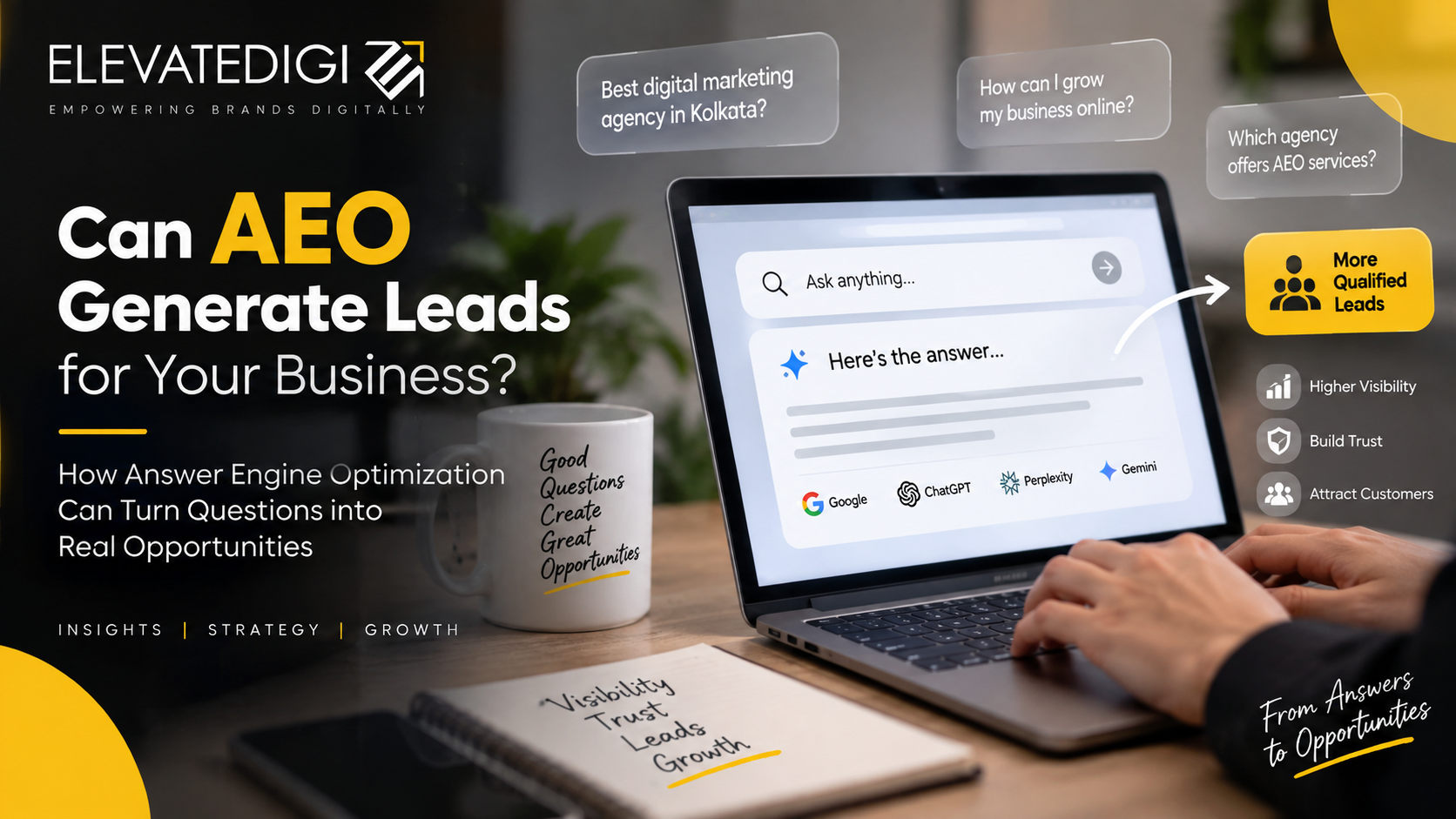
  • Can AEO Generate Leads for Your Business?

    Can AEO Generate Leads for Your Business?

    Search behaviour is changing. People are no longer relying only on traditional search results to find information, compare businesses, or make buying decisions. With the rise of AI-powered search and answer engines, users can now ask questions in a conversational way and receive direct, summarised answers.

    This shift has made AEO for Lead Generation an increasingly relevant strategy for businesses that want to be discovered when potential customers are actively looking for solutions.

    But does appearing in an AI-generated answer actually help a business generate leads?

    The short answer is yes, AEO can contribute to lead generation, but it should not be treated as a replacement for SEO, paid advertising, landing-page optimisation, or a strong conversion strategy. Instead, AEO works as another layer of digital visibility that can help businesses become part of the consideration process.

    For businesses such as service providers, agencies, SaaS companies, consultants, healthcare brands, educational institutions, and local businesses, this can create new opportunities to reach potential customers earlier in their decision-making journey.


    What Is AEO?

    Answer Engine Optimization, commonly known as AEO, is the process of optimising digital content so that it has a better chance of being understood, selected, and referenced by answer engines and AI-powered search experiences.

    Traditional SEO generally focuses on helping webpages rank for relevant search queries. AEO goes a step further by focusing on the way people ask questions and how search and AI systems interpret information to provide direct answers.

    For example, someone looking for a digital marketing agency may no longer search only for “digital marketing agency near me.” They might ask an AI-powered search engine:

    “Which digital marketing agencies can help a growing business improve its online visibility?”

    The answer may mention specific companies, services, websites, or sources. If your business has established relevant content and strong digital authority, your brand has an opportunity to become part of that answer ecosystem.

    AEO for lead generation

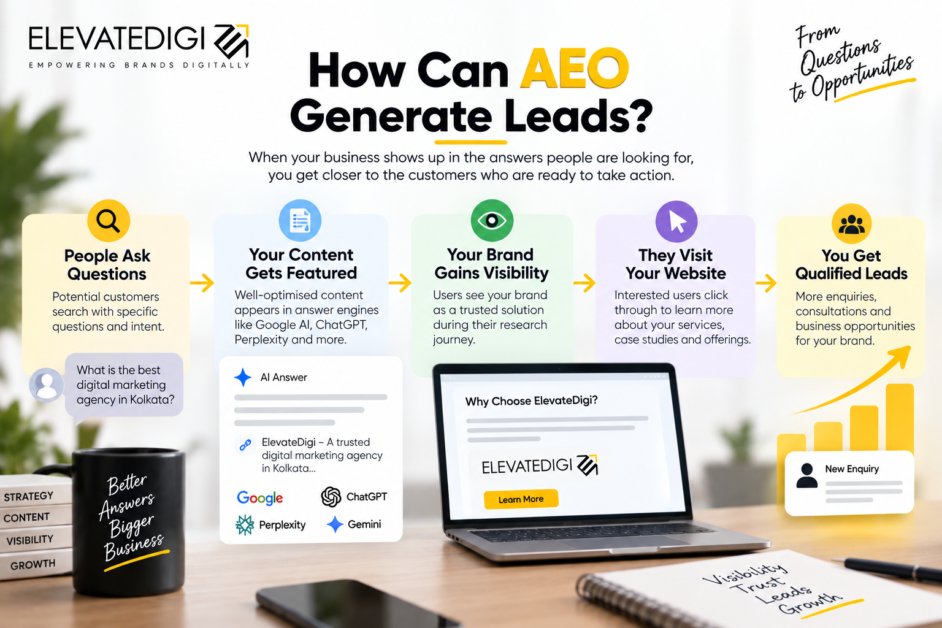
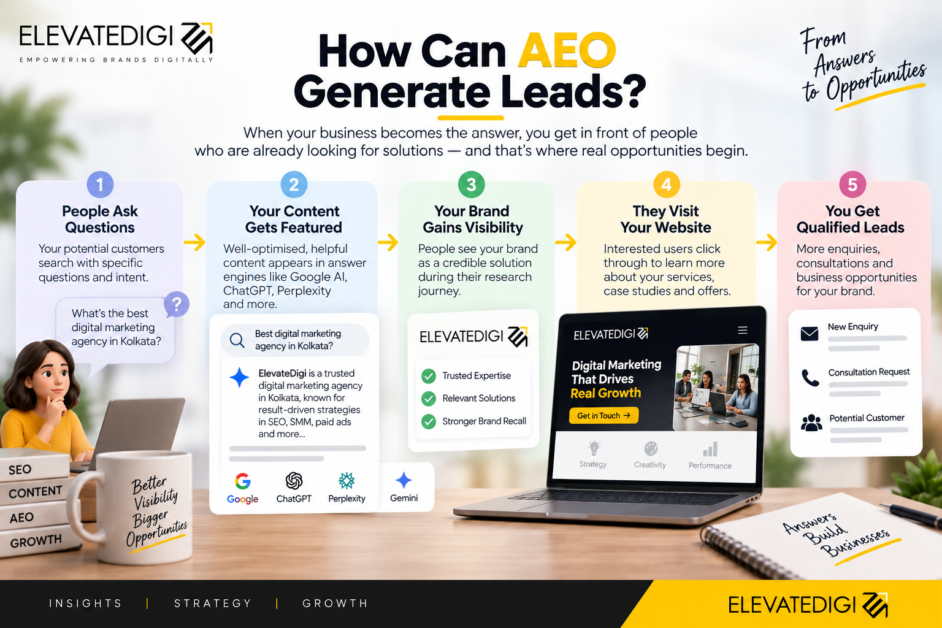
    How Can AEO Generate Leads?

    AEO Helps You Reach People With Specific Intent

    One of the biggest opportunities with AEO for Lead Generation comes from question-based searches.

    People asking detailed questions are often looking for more than general information. They may already be researching a problem, comparing solutions, or trying to understand which service provider can help them.

    Consider a user searching for:

    “What should I look for when choosing an SEO agency?”

    This person may not be ready to contact an agency immediately, but they are clearly exploring a commercial decision. A useful, trustworthy answer can introduce your brand at exactly this stage.

    When your content answers these questions effectively, it can create an initial point of contact between your business and a potential customer.

    AEO Can Build Brand Visibility Before the Click

    One important difference between traditional search and answer engines is that users may encounter your brand directly within an answer.

    Even when the user does not immediately visit your website, the appearance of a company in a relevant answer can contribute to brand awareness. If the user later searches for the company, visits its website, or mentions it while comparing options, that initial exposure may become part of the customer journey.

    This is particularly important for businesses operating in competitive industries where several companies offer similar services.

    AEO can therefore work beyond the simple objective of getting a website click. It can help businesses become more visible during the research and consideration stages.

    AEO for lead generation


    AEO and SEO Work Together

    AEO should not be considered a completely separate replacement for SEO.

    In reality, many of the foundations overlap.

    A business still needs useful content, technically accessible webpages, clear website structure, topical authority, credible information, and a good user experience. These elements support both traditional search visibility and the ability of AI-powered systems to understand a website.

    The difference is largely in the optimisation approach.

    SEO often focuses heavily on keywords, rankings, backlinks, technical performance, and search intent. AEO places additional emphasis on answering specific questions clearly, structuring information logically, demonstrating expertise, and making content easy for search and AI systems to interpret.

    For this reason, a well-planned digital strategy can combine SEO and AEO rather than treating them as competing approaches.


    What Type of Content Can Support AEO Lead Generation?

    Question-Based Content

    Questions are at the centre of answer-driven search.

    Businesses can create content around genuine questions their potential customers ask before purchasing a product or service. These questions can cover pricing, comparisons, processes, benefits, common mistakes, implementation, timelines, and other concerns.

    For example, a Salesforce consulting company could create content answering questions such as “How much does Salesforce implementation cost?” or “What does a Salesforce consultant actually do?”

    The objective should not be to create content simply because a question contains a keyword. The answer needs to provide genuine value.

    Service-Specific Content

    Service pages also have an important role.

    A business should clearly explain what it offers, who the service is for, what problems it solves, and what makes its approach different. This gives search and answer engines more meaningful information about the organisation.

    For example, AEO Services in Kolkata can be supported by detailed service content explaining AEO strategy, content optimisation, entity visibility, question-based search, and measurement.

    Educational Blogs

    Educational content can help establish topical depth.

    Instead of publishing isolated articles targeting individual keywords, businesses can build a collection of related content around a particular subject. Over time, this can demonstrate that the website has substantial coverage of the topic.

    This approach is especially useful for businesses operating in specialised or competitive markets.


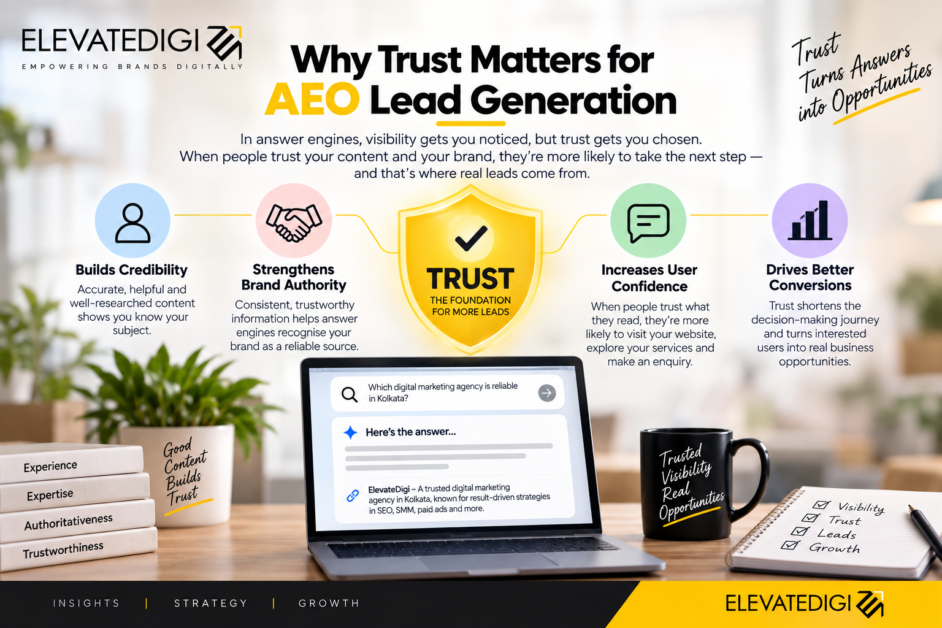
    Why Trust Matters for AEO Lead Generation

    Getting mentioned in an answer is only one part of the journey. The next question is whether the person trusts the brand enough to take action.

    This is where E-E-A-T principles become important.

    Experience, Expertise, Authoritativeness, and Trustworthiness help demonstrate that content is created by people who understand the subject and can provide reliable information.

    Businesses can strengthen these signals by presenting accurate information, using credible sources where appropriate, demonstrating practical experience, maintaining clear author and company information, and keeping important content updated.

    For ElevateDigi, this means creating content that reflects real digital marketing knowledge rather than simply producing pages designed around keywords.

    AEO works best when the content is genuinely useful first and optimised second.


    How AEO Can Move a Prospect Toward Conversion

    AEO generally works as part of a broader customer journey.

    A potential customer may first encounter a brand while asking an informational question. They may then search for the company separately, visit its website, read a service page, explore case studies, and eventually submit an enquiry.

    This means businesses should not measure AEO only by direct lead submissions.

    Brand mentions, referral traffic, organic visibility, branded searches, engagement with informational content, enquiries, and assisted conversions can all provide useful insights into whether the overall strategy is contributing to business growth.

    The exact measurement framework will depend on the industry, sales cycle, website structure, and type of conversion being targeted.


    Can AEO Replace Paid Advertising?

    No.

    Paid advertising can provide immediate visibility for targeted searches, while AEO is primarily focused on building organic visibility within answer-driven search experiences.

    A business that depends entirely on one channel may miss potential customers who discover brands through other routes.

    A stronger approach is to understand how different channels work together. SEO can support organic rankings, paid advertising can capture immediate demand, social media can build awareness, content can educate prospects, and AEO can improve visibility across conversational and answer-based search experiences.


    How ElevateDigi Approaches AEO

    At ElevateDigi, AEO is approached as part of a broader digital visibility strategy rather than as a standalone content exercise.

    The focus is on understanding what potential customers are asking, identifying relevant topics, creating useful answers, strengthening website content, and building a consistent digital presence around the brand’s expertise.

    For businesses exploring AEO Services in Kolkata, the objective should not simply be to appear in an AI-generated answer. The larger goal is to create a digital presence that makes the business easier to discover, understand, trust, and ultimately contact.

    That requires alignment between content, SEO, website experience, brand authority, and conversion strategy.


    The Future of AEO and Lead Generation

    AI-powered search is still evolving, and the way people discover businesses online will continue to change.

    As users become more comfortable asking complete questions rather than entering short keywords, businesses will need to think beyond traditional ranking positions. Being able to provide clear, credible, useful information can become an important part of maintaining visibility in this changing search environment.

    However, businesses should avoid treating AEO as a guaranteed source of leads. Visibility does not automatically equal conversion.

    A successful strategy connects visibility with a strong website, relevant services, compelling proof, clear calls to action, and a smooth enquiry process.


    Final Thoughts

    AEO for Lead Generation has the potential to help businesses reach prospective customers during important research and decision-making moments.

    It can improve the chances of a brand being discovered through answer engines, strengthen online authority, and create additional touchpoints throughout the customer journey. But the real value comes when AEO is combined with quality content, SEO, a trustworthy website, and a well-designed conversion strategy.

    For businesses preparing for the next stage of search, the question is no longer only about ranking for keywords. It is also about becoming a useful and credible answer when potential customers start asking questions.


    Frequently Asked Questions

    1. Does AEO directly generate leads?

    AEO can contribute to lead generation by increasing a brand’s visibility in answer-driven search experiences. However, appearing in an answer does not guarantee a lead. Conversion also depends on factors such as search intent, brand trust, website experience, service relevance, and calls to action.

    2. How is AEO different from SEO?

    SEO primarily focuses on improving a website’s visibility in search engine results, while AEO focuses more heavily on providing clear answers to questions used in conversational and AI-powered search experiences. The two strategies overlap significantly and can be implemented together.

    3. What businesses can benefit from AEO for lead generation?

    Service-based businesses, SaaS companies, consultants, agencies, healthcare providers, educational organisations, e-commerce businesses, and local businesses can potentially benefit from AEO. The opportunity depends on whether their target audience uses question-based and answer-driven search to research products or services.

    4. How long does it take to see results from AEO?

    There is no universal timeline. Results can depend on the website’s existing authority, content quality, competition, technical health, topic coverage, and how quickly search and answer engines process and surface the information. AEO should generally be viewed as a long-term digital visibility strategy rather than an instant lead-generation channel.

    5. Can AEO work alongside SEO and paid advertising?

    Yes. AEO, SEO, and paid advertising can serve different purposes within the same marketing strategy. SEO can support organic search visibility, paid advertising can capture targeted demand, and AEO can help a business become more visible within conversational and answer-based search experiences. Combining these channels can create a broader digital acquisition strategy.


Copyright © ElevateDigi. All Rights Reserved.