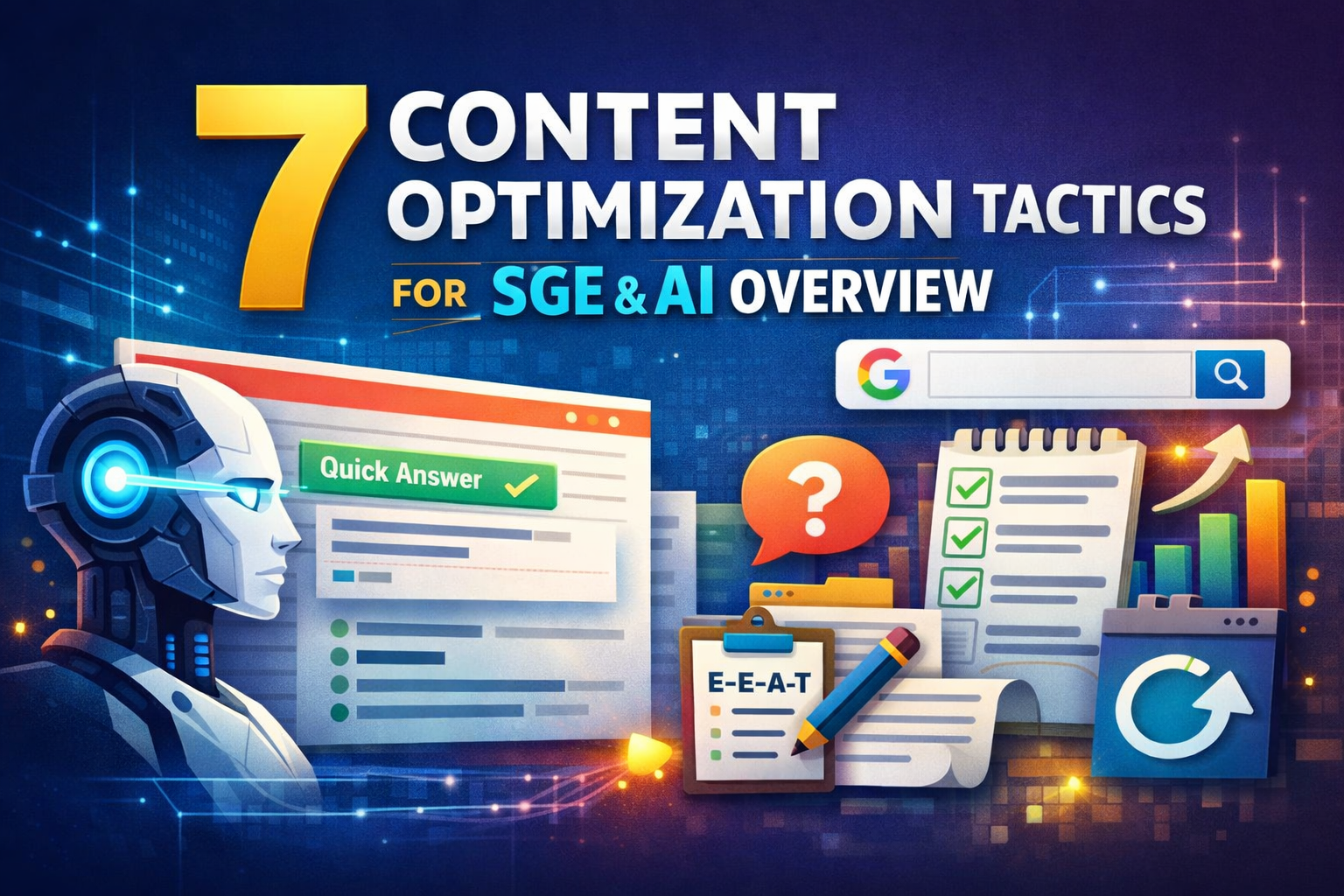
Search engines no longer work the way they used to. With Google’s Search Generative Experience (SGE) and AI Overviews, ranking is no longer just about backlinks or keyword density. It’s about how clearly your content answers a question.
AI doesn’t read your content like a human.
It scans for meaning. It looks for structure. And it selects pages that deliver answers fast.
If you want your pages to appear in AI-generated results, you need to rethink content optimization. Here are seven proven tactics that actually work in the SGE era.
1. Why Should You Answer First and Explain Later?
The most important answer should appear in the first 2–3 lines of your content.
AI systems don’t wait for long introductions. If the answer is buried deep in your content, AI may never pick it up.
Once the answer is clearly stated, you can expand on it with explanations, examples, and supporting details.
Why this works
SGE and AI Overviews are designed to extract direct answers, not stories. The faster your page delivers clarity, the higher the chance it gets featured.
When it applies
This works best for:
- How-to guides
- Definitions
- FAQs
- Problem-solution content
If your introduction delays the answer, AI often skips the page entirely.
2. How Does Writing Like You Speak Improve Content Optimization?
AI prefers content that sounds natural and human.
That means:
- Short sentences
- Simple words
- No forced keywords
If your content sounds robotic to a human reader, it won’t work for AI either.
Why this matters
Modern AI models are trained on real conversations. They recognize clarity and simplicity far better than complex, keyword-stuffed paragraphs.
A good rule of thumb:
If you wouldn’t say the sentence out loud, rewrite it.
3. Why Are Question-Based Headings Better for AI Results?
Headings act as signals for AI.
When your headings are written as real questions, AI understands your content faster.
Example
❌ Content Optimization Techniques
✔️ How do you optimize content for AI search results?
Why this works
SGE is built around search intent and questions. When your headings match how users search, AI can instantly map your content to a query.
This small change can significantly improve how your content is interpreted.
4.Why Should One Page Focus on One Clear Intent?
SGE dislikes confused pages.
Don’t mix:
- Definitions
- Comparisons
- Tutorials
- Multiple topics
One page should answer one main question completely.
Why this works
AI tries to classify your page within seconds. If it can’t identify a single intent, it won’t trust your content enough to feature it.
Clear intent is now a core principle of effective content optimization.
5. Why Context Matters More Than Word Count
Long content doesn’t win.
Clear, helpful content does.
Instead of adding fluff, focus on context:
- When this approach works
- When it doesn’t
- Common mistakes to avoid
Remove anything that doesn’t directly help answer the main question.
Reality check
AI does not reward length.
It rewards relevance and usefulness.
6. How Does Showing Experience Help with E-E-A-T?
AI prefers content that feels real, not generic.
Mention:
- What you tested
- What failed
- What surprised you
Generic advice blends in.
Experience stands out.
This is especially important for Experience and Expertise, two critical components of Google’s E-E-A-T framework.
When strategies are tested and documented—like we do while working with clients as an SEO Agency Kolkata businesses rely on—it builds trust with both users and AI systems.
7. Why Refreshing Old Content Is Critical for SGE?
SGE strongly favors fresh, updated content.
Refreshing old pages doesn’t mean changing dates. It means improving:
- Opening answers
- Examples
- Structure
- Overall clarity
Many websites see faster gains by updating existing pages than by publishing new ones.
This approach is often used by any serious SEO Company in Kolkata focused on long-term visibility rather than short-term traffic spikes.
Final Takeaway
If AI can’t understand your page in the first few lines, it won’t feature it.
In the age of SGE and AI Overviews:
- Clarity beats creativity
- Structure beats storytelling
- Experience beats theory
Strong content optimization today means writing content that humans trust and AI can understand instantly.