Tag: SEO

  • The Complete Guide to SEO for Beauty Brands (2026 Edition)

    The Complete Guide to SEO for Beauty Brands (2026 Edition)

    If you’re a founder of a skincare, cosmetic, or personal care brand, chances are you’ve searched something like “how to grow my beauty brand organically” or “why is my website not ranking on Google?” This guide is written specifically for you — the entrepreneur who wants sustainable, compounding growth without depending entirely on paid ads.

    This is not a surface-level overview. This is a practical, experience-driven roadmap to implementing SEO for beauty brands in a way that builds authority, traffic, and long-term revenue.


    Why SEO for Beauty Brands Is a Growth Asset — Not Just Marketing

    The beauty industry is built on search behavior. Consumers constantly look for solutions before they purchase. They search for ingredient benefits, compare brands, and read educational content before trusting a product on their skin.

    Brands like The Ordinary built massive global authority by ranking for ingredient-focused queries and educating customers deeply. In India, companies such as Minimalist and Mamaearth leveraged content and search visibility to accelerate brand trust.

    This is where a structured beauty brand SEO strategy becomes powerful. SEO is not about inserting keywords into pages. It is about positioning your brand where buyers are already looking.

    Paid ads can bring temporary visibility. But SEO for cosmetic brands builds discoverability that compounds over time.


    Understanding Search Intent in Skincare Brand SEO

    If you want to win with skincare brand SEO, you must understand intent.

    When someone searches “what is niacinamide,” they are learning. When they search “best niacinamide serum for acne,” they are comparing. When they search “buy niacinamide serum online,” they are ready to purchase.

    Your strategy must cover all three stages.

    Early-stage content builds trust. Mid-stage content builds authority. Bottom-stage content converts. A complete beauty brand SEO strategy connects these layers instead of treating them separately.


    Building a Keyword Foundation for SEO for Skincare Products

    A common mistake founders make is targeting only broad keywords like “face serum” or “moisturizer.” These are competitive and vague.

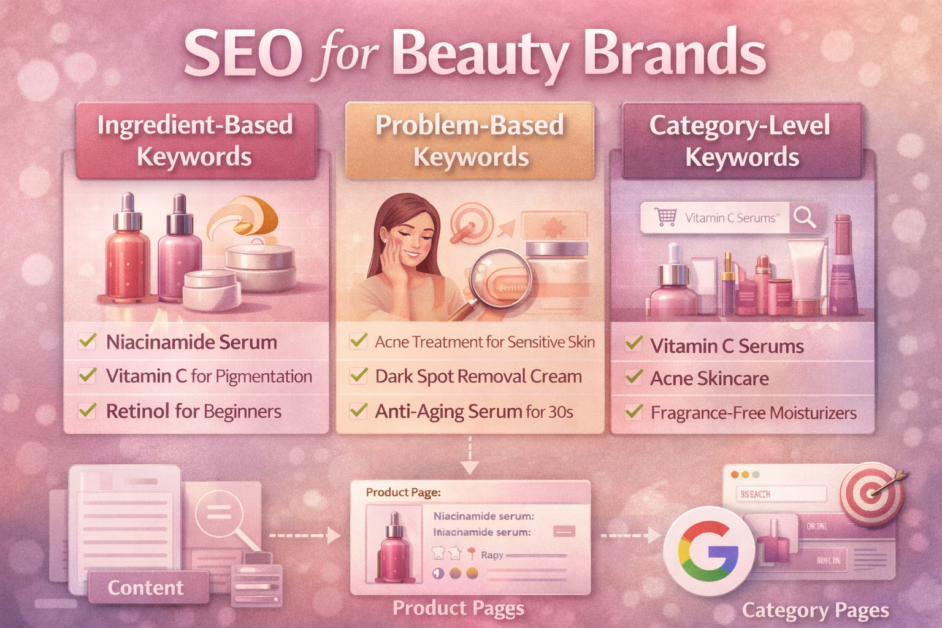
    Strong SEO for skincare products focuses on three keyword categories: ingredient-based, problem-based, and category-level searches.

    Ingredient searches such as niacinamide serum, vitamin C for pigmentation, or retinol for beginners are extremely valuable because they attract informed buyers. Problem-based searches like acne treatment for sensitive skin or dark spot removal cream bring users actively seeking solutions. Category-level searches such as vitamin C serums or fragrance-free moisturizers help scale traffic across product lines.

    When structured properly, these layers support your overall SEO for beauty brands approach.
    SEO for Beauty Brands


    Product Page Depth: The Core of Cosmetic Ecommerce SEO

    In cosmetic ecommerce SEO, your product page is your money page. Unfortunately, many brands upload short descriptions and expect Google to rank them.

    Search engines reward clarity and depth. A strong product page should clearly explain what the product does, who it is for, which skin types benefit, how to use it, and how it compares to alternatives. It should address real concerns customers search for.

    When executed properly, this strengthens both SEO for skincare products and broader SEO for cosmetic brands.

    Instead of copying supplier descriptions, add original explanations, usage guidance, FAQs, and internal links to related educational content. This signals experience and expertise — key components of trust in competitive beauty markets.


    Category Pages: The Silent Growth Engine in Cosmetic Ecommerce SEO

    Most beauty founders overlook category pages. They treat them as simple product grids.

    However, optimized category pages are powerful assets in cosmetic ecommerce SEO. A vitamin C category page should not just list products. It should explain different forms of vitamin C, ideal skin types, common concerns, and layering tips.

    This strengthens your topical authority and supports your entire beauty brand SEO strategy.

    Google ranks pages that genuinely help users understand their choices. If your category pages educate instead of merely displaying products, rankings improve significantly.


    Content Authority and Long-Term SEO for Beauty Brands

    Content marketing in beauty is not about publishing random blog posts. It is about building topical authority.

    For example, instead of writing disconnected articles, create a comprehensive guide on a single ingredient and support it with detailed subtopics. This strengthens your overall skincare brand SEO and helps Google associate your brand with expertise in that area.

    When your educational content links strategically to your product pages, you naturally enhance SEO for skincare products while building brand credibility.

    This is how educational brands outperform aggressive advertising brands over time.


    E-E-A-T: The Trust Multiplier in SEO for Cosmetic Brands

    Because skincare impacts health, Google evaluates beauty websites carefully. Experience, Expertise, Authoritativeness, and Trustworthiness matter deeply.

    Demonstrating real formulation insights, transparent ingredient breakdowns, and clear product instructions builds experience. Referencing credible dermatological research builds expertise. Being cited or mentioned by respected beauty publications builds authority. Transparent policies, secure checkout, and accessible customer support build trust.

    Without these signals, even technically strong SEO for beauty brands may struggle in competitive markets.


    Technical Strength Behind a Winning Beauty Brand SEO Strategy

    Even the best content fails if technical foundations are weak. Slow loading speeds, duplicate variant URLs, thin pages, and poor internal linking can undermine your entire beauty brand SEO strategy.

    Optimizing performance, cleaning URL structures, improving internal navigation, and ensuring mobile responsiveness are critical components of serious cosmetic ecommerce SEO.

    Founders often ignore these because they are invisible to customers — but they are highly visible to search engines.


    The Reality of Timeframes in SEO for Beauty Brands

    One of the most common questions entrepreneurs ask is how long results take.

    Realistically, early technical improvements may show movement within a few months. Noticeable organic traffic growth typically builds between three to six months. Strong compounding results often appear after consistent execution for six to twelve months.

    SEO for beauty brands is not a quick hack. It is a long-term growth engine.


    Final Thoughts for Beauty Entrepreneurs

    If you’re reading this, you are likely looking for sustainable growth. You want to reduce dependency on ads. You want customers to discover your brand while searching for solutions.

    That is exactly what structured SEO for beauty brands delivers.

    A smart beauty brand SEO strategy integrates technical foundations, optimized product pages, authoritative educational content, and strong trust signals. When aligned properly, skincare brand SEO, cosmetic ecommerce SEO, and SEO for skincare products work together instead of operating in isolation.

    Organic visibility builds authority. Authority builds trust. Trust builds revenue.

    And in today’s competitive market, trust is your most powerful advantage.

    If you’d like, I can now optimize this for publishing with a high-converting meta title and description tailored to entrepreneurs searching for SEO for beauty brands.

    Frequently Asked Questions (FAQs)


    1. What is SEO for beauty brands?

    SEO for beauty brands is the process of optimizing a skincare or cosmetic website to rank higher on Google for ingredient, product, and problem-based searches. It includes keyword research, product page optimization, content marketing, technical improvements, and building trust signals to increase organic traffic and sales.

    2. How long does SEO take to work for a skincare brand?

    For most businesses implementing skincare brand SEO, noticeable improvements start within 3–6 months. Strong and consistent results from a structured beauty brand SEO strategy typically compound over 6–12 months, depending on competition and execution quality.

    3. Is SEO better than paid ads for cosmetic brands?

    SEO for cosmetic brands builds long-term, compounding traffic, while paid ads generate immediate but temporary visibility. The most sustainable approach is combining both, but strong cosmetic ecommerce SEO reduces dependency on ads over time and increases profit margins.

    4. What are the most important keywords for SEO for skincare products?

    The most important keywords for SEO for skincare products include ingredient-based terms (like niacinamide serum), problem-based searches (like acne treatment for sensitive skin), and category-level keywords (like vitamin C serums). These attract high-intent customers ready to purchase.

    5. What is the biggest mistake beauty entrepreneurs make with SEO?

    The biggest mistake in SEO for beauty brands is focusing only on social media or influencer marketing while ignoring website optimization. Without a proper beauty brand SEO strategy, brands miss out on customers actively searching for their products on Google.
  • Stop Blogging Daily: It’s Not Helping Your SEO

    Stop Blogging Daily: It’s Not Helping Your SEO

    For a long time, businesses have been told that consistency is the key to SEO success. The advice sounds simple: publish blogs daily, stay active, and rankings will follow.

    But in reality, SEO blogging doesn’t work that way anymore.

    Many websites publish content every day and still fail to grow. Traffic remains stagnant, rankings don’t improve, and leads never arrive. The issue isn’t a lack of effort—it’s a misunderstanding of how search engines evaluate content today.

    Blogging Daily Won’t Fix Your SEO — Here’s Why

    Daily publishing creates the illusion of progress. You see new URLs, fresh content, and regular activity. But Google doesn’t measure effort; it measures usefulness.

    Modern SEO blogging is not about how often you publish. It’s about whether your content genuinely helps users.

    That’s why most websites that blog daily still don’t grow.

    The Myth: More Blogs Automatically Mean Better Rankings

    Many website owners believe that publishing more blogs will naturally lead to better rankings. The logic feels sound—more pages should mean more chances to rank.

    So they keep publishing.
    Every single day.

    Unfortunately, Google doesn’t reward volume alone. Without focus, strategy, and intent, more content simply means more ignored pages.

    The Reality Shift: Google Doesn’t Reward Activity

    Search engines don’t care how busy your content calendar is. They care about results.

    Daily effort does not equal SEO growth.

    Google looks at signals like:

    • Does this page satisfy the search intent?
    • Does it offer clarity or depth?
    • Does it add something new compared to existing results?

    If the answer is no, frequency won’t help.

    This shift is why SEO blogging today requires strategy, not speed.

    Why Most Blogs Fail to Rank

    Most blogs fail because they lack purpose.

    They often:

    • Target random topics with no keyword strategy
    • Exist only to “post something”
    • Fail to solve a specific user problem

    From an SEO perspective, these pages don’t deserve to rank because they don’t provide value. They dilute authority instead of building it.

    One Helpful Page Beats Dozens of Average Posts

    A single focused, well-researched page can outperform thirty average blog posts.

    Why? Because quality compounds.

    Strong SEO blogging creates:

    • Long-term relevance
    • Higher engagement
    • Natural backlinks
    • User trust

    Quantity doesn’t compound. It just fills your website with pages Google has no reason to prioritize.

    Why Google Quietly Ignores Most Blogs

    Google doesn’t punish weak content—it simply ignores it.

    If your blog:

    • Doesn’t match what users are actually searching for
    • Repeats what already exists online
    • Doesn’t help users make decisions

    It won’t rank.

    During audits conducted by any experienced SEO Company in Kolkata, this is one of the most common findings: plenty of content, but very little value.

    What Actually Works in SEO Blogging

    Real SEO growth comes from fewer, stronger pages.

    Effective SEO blogging focuses on:

    • Clear intent and topic focus
    • Direct, useful answers
    • First-hand experience and expertise
    • Content written for humans, not algorithms

    This is why a professional SEO Agency in Kolkata will often recommend improving existing pages instead of publishing new ones daily.

    Optimization beats repetition.

    The Business Perspective Most Websites Miss

    Blogs don’t rank because they exist.

    They rank because they deserve to exist.

    Search engines follow users. If users trust, read, and engage with your content, rankings follow naturally. That’s the difference between content written to “stay consistent” and content written to create impact.

    The Biggest SEO Blogging Mistake

    Most websites blog daily to feel productive.

    But Google doesn’t reward productivity.
    It rewards results.

    If a blog post doesn’t educate, clarify, or solve a problem, publishing it more often won’t change the outcome.

    Conclusion

    Before writing your next blog, pause for a moment.

    Ask yourself:

    • Who is this content actually for?
    • What problem does it solve?
    • Why should this page rank?

    Understanding this is the foundation of effective SEO blogging. And reading this blog before publishing your next one might save you months of wasted effort.

    FAQ’s

    1. Does blogging daily help SEO?

    No, blogging daily does not automatically improve SEO. Search engines prioritize content quality, relevance, and user intent over publishing frequency. One well-optimized, helpful page can outperform dozens of low-quality posts.

    2. What is SEO blogging?

    SEO blogging is the practice of creating content that solves specific user problems, matches search intent, and provides clear, valuable answers that search engines can trust and rank.

    3. How often should I publish blog content for SEO?

    There is no fixed number. Publishing fewer high-quality, focused blog posts is more effective than posting daily without a clear strategy. Consistency matters only when content delivers value.

    4. Why don’t my blog posts rank on Google?

    Most blog posts fail to rank because they don’t match search intent, don’t add new insights, or don’t help users make decisions. Google quietly ignores content that lacks usefulness or originality.

    5. What matters more for SEO—quality or quantity?

    Quality matters far more than quantity. High-quality content builds authority, earns trust, and attracts backlinks, while large volumes of average content rarely improve rankings.

  • SEO Techniques in 2026: Advanced Strategies to Boost Your Rankings

    SEO Techniques in 2026: Advanced Strategies to Boost Your Rankings

    As SEO evolves, 2026 presents a new set of challenges and opportunities for businesses striving to stay competitive. Whether you’re an SEO Company in Kolkata or a business trying to improve your rankings, leveraging advanced SEO techniques is key. This blog will take you through the most effective strategies for boosting rankings in 2026, ensuring your website stays ahead in this ever-changing landscape.


    1. Implement Structured Data Markup

    Structured data is becoming a cornerstone of SEO in 2026. With the increasing importance of search engine understanding and rich results, it’s essential to implement structured data on your website.

    Steps to Implement Structured Data Markup:

    • Use Google’s Structured Data Markup Helper: Google’s tool helps generate the code for your site’s structured data.
    • Add the Code to Your Website: Once generated, add the code to your website’s HTML.
    • Test with Google’s Structured Data Testing Tool: This will allow you to check if your structured data is properly formatted before going live.

    By optimizing for structured data, you can increase your chances of ranking higher in search results, particularly in SEO Trends 2026 like featured snippets and knowledge panels.


    2. Optimize for Featured Snippets

    Featured snippets are becoming a prominent feature of search results. Appearing in this top spot can significantly boost your organic traffic.

    Tips for Optimizing for Featured Snippets:

    • Identify Snippet Opportunities: Look for questions related to your niche and target these opportunities for better ranking potential.
    • Structure Your Content: Use headers, bullet points, and concise answers that search engines can easily pick up.
    • Use Headers: Clearly defined headers (H1, H2, etc.) improve the likelihood of your content being featured in a snippet.

    This tactic is especially crucial for businesses offering services, like an SEO agency in Kolkata, looking to dominate local search results.


    3. Leverage Advanced Link Building Strategies

    Link building remains vital in 2026, but the focus has shifted from quantity to quality. Building high-authority backlinks will enhance your domain authority and improve your search engine rankings.

    Advanced Link Building Techniques:

    • Skyscraper Technique: Find high-ranking content in your industry, create better content, and reach out to websites that link to the original content to secure backlinks.
    • Broken Link Building: Look for broken links on authoritative sites in your niche and offer your content as a replacement.
    • Resource Page Link Building: Contact resource pages relevant to your industry and request your content be added.

    For an SEO Company in Kolkata, mastering these strategies is critical for staying ahead of the competition.


    4. Optimize for Voice Search

    With the growing popularity of voice-activated devices, voice search optimization is essential for modern SEO strategies.

    Voice Search Optimization Tips:

    • Use Natural Language: Voice search queries are more conversational, so ensure your content mimics natural speech.
    • Include Long-Tail Keywords: Voice searches tend to be longer and more specific, so focus on targeting long-tail keywords.
    • Answer Questions: Voice search is typically query-based, so aim to provide clear, concise answers to questions.

    Optimizing for voice search is part of the broader SEO Strategy in 2026 and should be incorporated into any SEO agency in Kolkata’s plan.


    5. Improve Core Web Vitals

    In 2026, Core Web Vitals are no longer optional but essential for SEO. These metrics focus on user experience, directly impacting your rankings.

    Key Metrics to Focus On:

    • Largest Contentful Paint (LCP): Aiming for fast load times, ideally under 2.5 seconds.
    • First Input Delay (FID): Ensure your site is responsive, with an FID under 100 milliseconds.
    • Cumulative Layout Shift (CLS): Ensure your content is visually stable to avoid layout shifts, aiming for a score under 0.1.

    For SEO Fundamentals in 2026, improving these core web metrics is crucial for maintaining top rankings.


    6. Create Comprehensive Content Hubs

    Content hubs allow you to organize your website into a cohesive structure that improves user experience and SEO.

    How to Create a Content Hub:

    • Choose a Core Topic: Select a topic that aligns with your target audience’s interests.
    • Create Pillar Content: Write detailed, in-depth content on the core topic.
    • Develop Cluster Content: Write supporting blog posts that link back to your pillar content.

    Content hubs are becoming a cornerstone of effective SEO Strategy in 2026, helping businesses establish authority and improve rankings.


    7. Utilize Internal Linking Strategically

    Internal linking plays a major role in SEO. A well-structured internal linking strategy will help search engines discover all your pages and ensure even distribution of link equity.

    Best Practices for Internal Linking:

    • Use Descriptive Anchor Text: Use keywords that describe the content you’re linking to.
    • Link to Relevant Content: Make sure your internal links are contextually relevant to the target page.
    • Maintain a Balanced Link Structure: Spread link equity evenly across your site to avoid over-optimizing any single page.

    By using internal linking strategically, you’ll improve navigation, ranking potential, and overall SEO performance. This technique is essential for SEO Companies in Kolkata looking to maximize their website’s SEO.


    8. Monitor and Adapt to Algorithm Changes

    Google’s algorithms are constantly evolving, and staying updated on these changes is vital for maintaining your rankings.

    Staying Updated:

    • Follow SEO News: Read SEO blogs and stay updated with news sites like Search Engine JournalMoz, and Google’s Webmaster Central Blog.
    • Use SEO Tools: Tools like AhrefsSEMrush, and Moz provide updates and insights on algorithm changes.
    • Analyze Traffic Patterns: Keep track of your site’s traffic and rankings to identify the impact of algorithm updates.

    Being proactive about algorithm changes is part of any SEO Strategy in 2026 that a business should adopt to stay competitive.

    Conclusion

    In 2026, SEO continues to evolve, and staying ahead means adopting cutting-edge strategies. From structured data markup and voice search optimization to advanced link building, businesses need to integrate multiple techniques for long-term success.

    For those looking for an SEO agency in Kolkata, partnering with a professional team ensures that all these advanced strategies are implemented effectively. Embrace SEO Trends 2026 to boost your rankings, and focus on the SEO Fundamentals in 2026 to build a solid foundation for future growth.

    Adapting to changes like AEO vs SEO in 2026 will give you a competitive edge, allowing you to rise above the competition and achieve top rankings in search results.

    FAQ’s

    1. What are the key SEO techniques for 2026?

    The key SEO techniques for 2026 include structured data markup, optimizing for featured snippets, advanced link building, voice search optimization, improving Core Web Vitals, creating comprehensive content hubs, and strategic internal linking.

    2. How does structured data markup impact SEO in 2026?


    Structured data markup helps search engines understand and display your content in richer ways, such as featured snippets and knowledge panels. Implementing it can improve visibility and click-through rates, leading to higher rankings.


    3. Why is voice search optimization important for SEO in 2026?


    With the rise of voice-activated devices, voice search is becoming a significant part of user behavior. Optimizing for voice search helps your website rank for conversational queries, making your content more accessible to voice search users.


    4. What is Core Web Vitals, and why does it matter for SEO in 2026?


    Core Web Vitals measure the user experience on your website, focusing on loading speed, interactivity, and visual stability. In 2026, Google continues to prioritize these metrics, making it essential to improve them for better rankings.


    5. How can I build high-quality backlinks for my website in 2026?


    In 2026, link building focuses on acquiring high-quality, relevant backlinks. Techniques like the skyscraper method, broken link building, and resource page link building are effective ways to earn authority-boosting links from reputable websites.


Copyright © ElevateDigi. All Rights Reserved.