If you’re a founder of a skincare, cosmetic, or personal care brand, chances are you’ve searched something like “how to grow my beauty brand organically” or “why is my website not ranking on Google?” This guide is written specifically for you — the entrepreneur who wants sustainable, compounding growth without depending entirely on paid ads.
This is not a surface-level overview. This is a practical, experience-driven roadmap to implementing SEO for beauty brands in a way that builds authority, traffic, and long-term revenue.
Why SEO for Beauty Brands Is a Growth Asset — Not Just Marketing
The beauty industry is built on search behavior. Consumers constantly look for solutions before they purchase. They search for ingredient benefits, compare brands, and read educational content before trusting a product on their skin.
Brands like The Ordinary built massive global authority by ranking for ingredient-focused queries and educating customers deeply. In India, companies such as Minimalist and Mamaearth leveraged content and search visibility to accelerate brand trust.
This is where a structured beauty brand SEO strategy becomes powerful. SEO is not about inserting keywords into pages. It is about positioning your brand where buyers are already looking.
Paid ads can bring temporary visibility. But SEO for cosmetic brands builds discoverability that compounds over time.
Understanding Search Intent in Skincare Brand SEO
If you want to win with skincare brand SEO, you must understand intent.
When someone searches “what is niacinamide,” they are learning. When they search “best niacinamide serum for acne,” they are comparing. When they search “buy niacinamide serum online,” they are ready to purchase.
Your strategy must cover all three stages.
Early-stage content builds trust. Mid-stage content builds authority. Bottom-stage content converts. A complete beauty brand SEO strategy connects these layers instead of treating them separately.
Building a Keyword Foundation for SEO for Skincare Products
A common mistake founders make is targeting only broad keywords like “face serum” or “moisturizer.” These are competitive and vague.
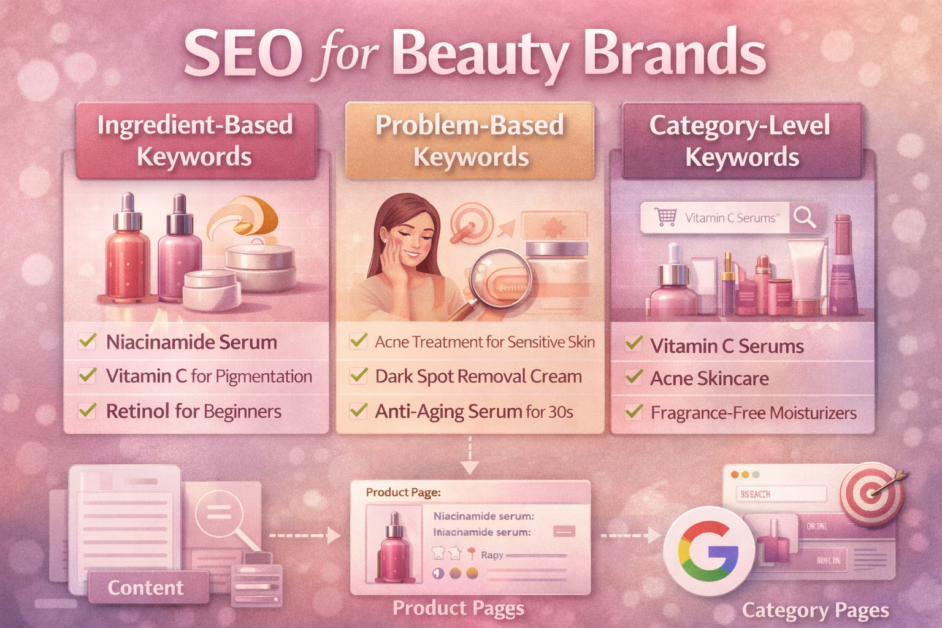
Strong SEO for skincare products focuses on three keyword categories: ingredient-based, problem-based, and category-level searches.
Ingredient searches such as niacinamide serum, vitamin C for pigmentation, or retinol for beginners are extremely valuable because they attract informed buyers. Problem-based searches like acne treatment for sensitive skin or dark spot removal cream bring users actively seeking solutions. Category-level searches such as vitamin C serums or fragrance-free moisturizers help scale traffic across product lines.
When structured properly, these layers support your overall SEO for beauty brands approach.
Product Page Depth: The Core of Cosmetic Ecommerce SEO
In cosmetic ecommerce SEO, your product page is your money page. Unfortunately, many brands upload short descriptions and expect Google to rank them.
Search engines reward clarity and depth. A strong product page should clearly explain what the product does, who it is for, which skin types benefit, how to use it, and how it compares to alternatives. It should address real concerns customers search for.
When executed properly, this strengthens both SEO for skincare products and broader SEO for cosmetic brands.
Instead of copying supplier descriptions, add original explanations, usage guidance, FAQs, and internal links to related educational content. This signals experience and expertise — key components of trust in competitive beauty markets.
Category Pages: The Silent Growth Engine in Cosmetic Ecommerce SEO
Most beauty founders overlook category pages. They treat them as simple product grids.
However, optimized category pages are powerful assets in cosmetic ecommerce SEO. A vitamin C category page should not just list products. It should explain different forms of vitamin C, ideal skin types, common concerns, and layering tips.
This strengthens your topical authority and supports your entire beauty brand SEO strategy.
Google ranks pages that genuinely help users understand their choices. If your category pages educate instead of merely displaying products, rankings improve significantly.
Content Authority and Long-Term SEO for Beauty Brands
Content marketing in beauty is not about publishing random blog posts. It is about building topical authority.
For example, instead of writing disconnected articles, create a comprehensive guide on a single ingredient and support it with detailed subtopics. This strengthens your overall skincare brand SEO and helps Google associate your brand with expertise in that area.
When your educational content links strategically to your product pages, you naturally enhance SEO for skincare products while building brand credibility.
This is how educational brands outperform aggressive advertising brands over time.
E-E-A-T: The Trust Multiplier in SEO for Cosmetic Brands
Because skincare impacts health, Google evaluates beauty websites carefully. Experience, Expertise, Authoritativeness, and Trustworthiness matter deeply.
Demonstrating real formulation insights, transparent ingredient breakdowns, and clear product instructions builds experience. Referencing credible dermatological research builds expertise. Being cited or mentioned by respected beauty publications builds authority. Transparent policies, secure checkout, and accessible customer support build trust.
Without these signals, even technically strong SEO for beauty brands may struggle in competitive markets.
Technical Strength Behind a Winning Beauty Brand SEO Strategy
Even the best content fails if technical foundations are weak. Slow loading speeds, duplicate variant URLs, thin pages, and poor internal linking can undermine your entire beauty brand SEO strategy.
Optimizing performance, cleaning URL structures, improving internal navigation, and ensuring mobile responsiveness are critical components of serious cosmetic ecommerce SEO.
Founders often ignore these because they are invisible to customers — but they are highly visible to search engines.
The Reality of Timeframes in SEO for Beauty Brands
One of the most common questions entrepreneurs ask is how long results take.
Realistically, early technical improvements may show movement within a few months. Noticeable organic traffic growth typically builds between three to six months. Strong compounding results often appear after consistent execution for six to twelve months.
SEO for beauty brands is not a quick hack. It is a long-term growth engine.
Final Thoughts for Beauty Entrepreneurs
If you’re reading this, you are likely looking for sustainable growth. You want to reduce dependency on ads. You want customers to discover your brand while searching for solutions.
That is exactly what structured SEO for beauty brands delivers.
A smart beauty brand SEO strategy integrates technical foundations, optimized product pages, authoritative educational content, and strong trust signals. When aligned properly, skincare brand SEO, cosmetic ecommerce SEO, and SEO for skincare products work together instead of operating in isolation.
Organic visibility builds authority. Authority builds trust. Trust builds revenue.
And in today’s competitive market, trust is your most powerful advantage.
If you’d like, I can now optimize this for publishing with a high-converting meta title and description tailored to entrepreneurs searching for SEO for beauty brands.
Frequently Asked Questions (FAQs)
1. What is SEO for beauty brands?
SEO for beauty brands is the process of optimizing a skincare or cosmetic website to rank higher on Google for ingredient, product, and problem-based searches. It includes keyword research, product page optimization, content marketing, technical improvements, and building trust signals to increase organic traffic and sales.
2. How long does SEO take to work for a skincare brand?
For most businesses implementing skincare brand SEO, noticeable improvements start within 3–6 months. Strong and consistent results from a structured beauty brand SEO strategy typically compound over 6–12 months, depending on competition and execution quality.
3. Is SEO better than paid ads for cosmetic brands?
SEO for cosmetic brands builds long-term, compounding traffic, while paid ads generate immediate but temporary visibility. The most sustainable approach is combining both, but strong cosmetic ecommerce SEO reduces dependency on ads over time and increases profit margins.
4. What are the most important keywords for SEO for skincare products?
The most important keywords for SEO for skincare products include ingredient-based terms (like niacinamide serum), problem-based searches (like acne treatment for sensitive skin), and category-level keywords (like vitamin C serums). These attract high-intent customers ready to purchase.
5. What is the biggest mistake beauty entrepreneurs make with SEO?
The biggest mistake in SEO for beauty brands is focusing only on social media or influencer marketing while ignoring website optimization. Without a proper beauty brand SEO strategy, brands miss out on customers actively searching for their products on Google.